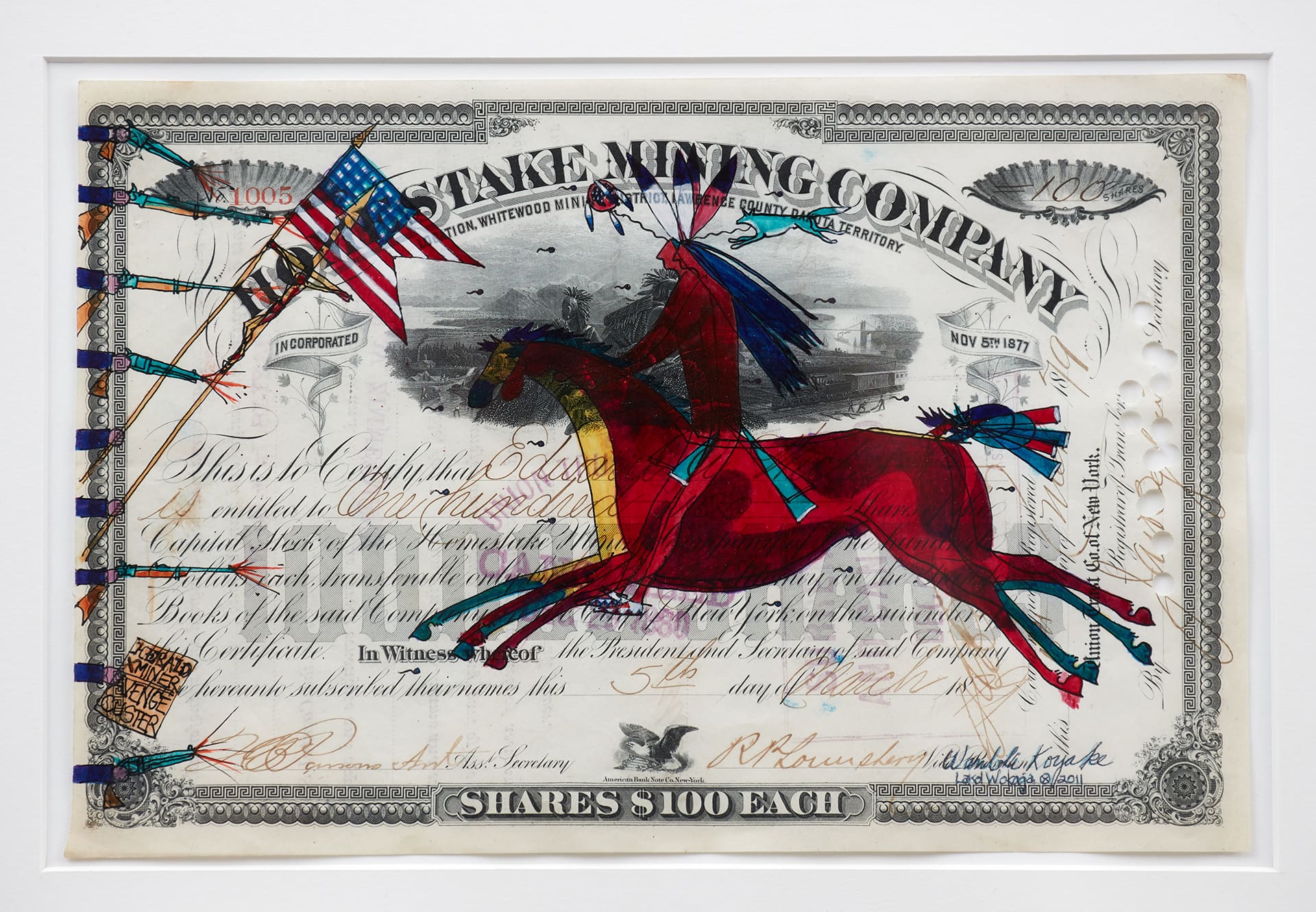
Francis Yellow
Ikicize Nunpa (Two Fighters), 2011
Ledger-style watercolor and ink painting
Gift of Russel Cowles
I chose Ikicize Nunpa (Two Fighters), as I hope to show you the resilience of my people, and how even now, we are still fighting. The native language being presented is from the Lakota nation, which some of its language can be referred to as as Lakhota, Teton or Teton Sioux
This artwork may be small, although I think it’s an excellent example of show-don’t-tell. I think it is pure irony that it is on what seems to be a so called “treaty” for a mining agreement, where they were promised $100 for the US government mining on their land, their homes, their sacred grounds, and I’m sure that those materials were worth more than a mere $100 dollars, which would be $3,619.78 today.
$3,619.78 dollars for your home?
Treaties were held over the first peoples heads, and the work I chose is one of the many representations of this, as the title shows it is known as, Ikicize Nunpa (Two Fighters), and yet it is not simply two fighters. It is two fighters resisting an already unfair treaty, and further more; an unfair fight. The two fighters, who I would assume to be the Native warrior, and his stead are facing off against a battalion of soldiers.
The soldiers not only brandish guns against the two warriors, but other items that were used to further discriminate and beat down natives: The concept of a “free country”, religion, and the treaties are facing against them, not with them; and yet they still fight bravely for their home, and their freedoms as the first people of this nation.
The “holes” in the back of the paper, and the back of the two warriors would represent the gunshots. So much is facing them, and they’re still unfazed. Religion is shown in the work as the oppressor, specifically christianity. You can see it as one of the soldiers is holding the crucifixion of Jesus Christ, and looks to me like it is shaped like a spear. The concept of America is shown through the use of the American flag; and finally, the treaty is shown through one of the battalion members holding a miniature treaty against the two warriors.
Resilience: an ability to recover from or adjust easily to misfortune or change. This was not easy, it is still not easy. It is not easy to face your oppressors, especially when they have a multitude of measures to beat you down. It is not easy to fight back, when it brings more and more destruction to your home, your culture, your language, your people.
We still fought, we are still fighting. Native culture, and Native Americans are still being oppressed, it will always be a battle.
But that can all change. Do your research, explore Native culture with respect, and please, be empathetic. Native people are here, and they aren’t leaving.
Help out your neighbors, be kind.
You have the capability to make a change, and I implore you to do so
Disclaimer: All of these findings are simply my interpretation, and I understand that these can be taken in a multitude of different directions.
How are Native’s still exploited in Fargo/MN. I’m sure everyone, especially in the Minnesota region, has felt the ever looming presence of ICE (Immigration and Customs Enforcement.) It seems that ICE is honing in on our nation’s first peoples; according to the Minnesota legislature “Native American Caucus Members Condemns Detainment and Racial Targeting of Native Americans by ICE.” Why is this relevant? Some may be asking themselves, “Everyone’s a target with ICE these days.” However; this is a true sign of decay for an organization, to go after the first peoples of our nation.
Native Americans are no strangers to discrimination, and hardship. This is the present representation of this: “Federal agents illegally detained four unsheltered Oglala Sioux relatives and Red Lake Nation descendant, Jose Roberto Ramirez, as countless community members report being harassed, stopped without cause, and interrogated for documentation. This is lawless abuse of power rooted in systemic racism — and it will not stand.
Mining treaties in the area: Now this is not an example of a mining treaty, however I do feel that this is applicable as it shows a right way to mine on ‘sacred’ Native land. This was a proctored agreement between the MHA nations, and the Cocteau properties in Bismark, ND, in 2007. This to me, is relevant as Bismark is simply a 2 hour drive away from the Fargo-Moorhead area, and as it is in the recent past, which to me I feel that a story like this would have been far more relevant in modern times, compared to 2007 which I see as a “less progressive time.” From what I am reading, I don’t see a direct cause for why they were mining at the site they were located on. It seems that they only excavated there and nothing more.
Now what did the tribe ask the mining company to preserve? A stone turtle effigy and other artifacts of cultural importance to tribal members. As I said in the beginning, this would be an agreement that is done right, and it seems that the mining company was quite respectful to the tribe’s wishes. The tribal chair, Marcus Levings had said “It was significant to me because they didn’t have to do that,” in regards to them excavating the sight while taking care to avoid the tribal site, and he finished with: “It is a step in the right direction for the industries along the Upper Missouri.” I believe this is how every process regarding “projects” on native land should be moving, the tribal chief and mining company were in close contact throughout this excursion, the mining company made sure to consult with the tribe if they had questions relating to any artifacts. There was no hostility, not fighting, simply teamwork at its finest. Unfortunately, it seems we are pedaling backwards, even though, for the future we should be moving forward.
Sources:
https://www.house.mn.gov/members/Profile/News/15539/41109