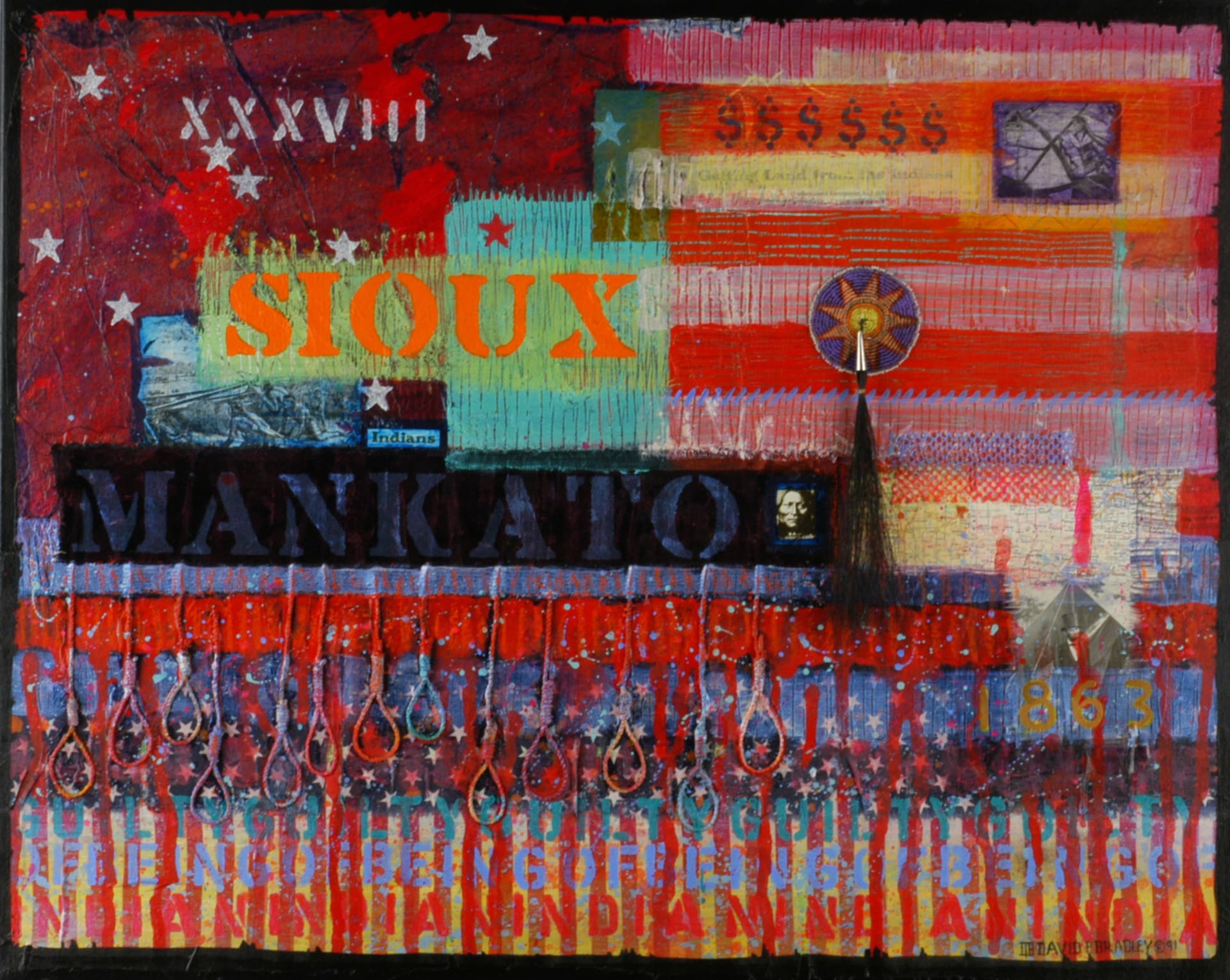
David P. Bradley (Ojiwe)
Guilty of Being Indian (Mankato), 1991
Painting
Plains Art Museum 1992.001.0002
Guilty of Being Indian is a mixed media artwork about the largest mass execution in U.S. history. It expresses the hurt and injustice that was faced as a result of the War of 1862. This artwork serves as a reminder that although a person is no longer physically here; their memory, stories, and resistance live on.
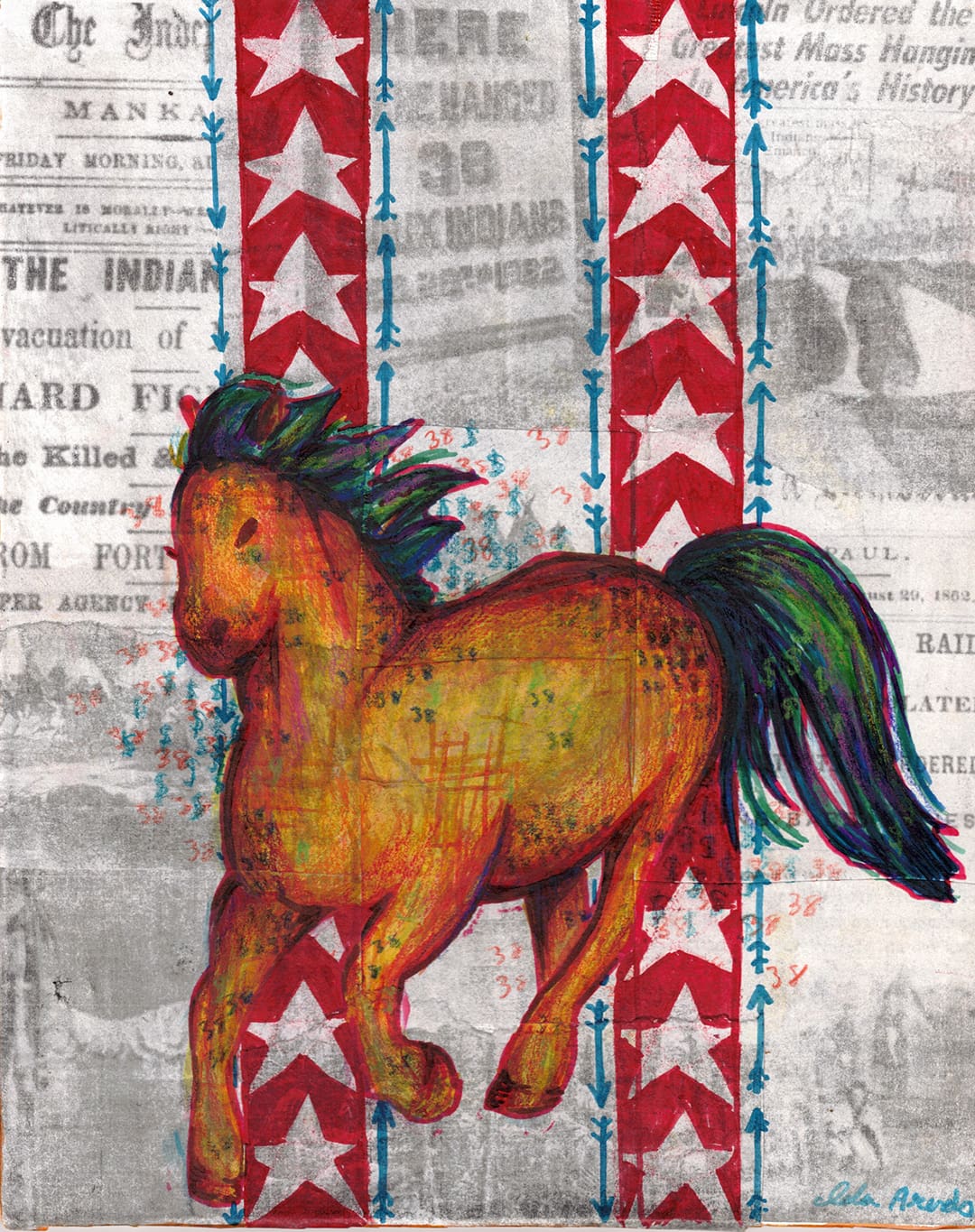
Ida Arends
38 +2, 2026
Paper, acrylic paint, alcohol markers, and colored pencils on a canvas
I created this artwork as a reflection on the information I have researched. It is mixed media on canvas; my materials used were paper, acrylic paint, alcohol markers, and colored pencils. I wanted to use this project as a way to interpret and process my feelings: my written portion of the research was heavy and disturbing. The background includes pictures of news clippings and photos taken during and after the war. In the front, there is a horse which symbolizes the high regard Dakota natives have for the creature, and because the memorial ride is mostly completed on horseback. Behind the horse, there are two stripes that serve as tribute to the men who were executed a few days after December 26, 1862.
I felt drawn to “Guilty of Being Indian” by David P. Bradley after learning about the Dakota 38 in school. I wanted to learn more, especially the context behind what led up to it and the emotions that had played a role in the outcome. The execution was a tragic and horrific part in both the history of Minnesota and the history of the plains and, unfortunately, it often gets overshadowed by the American Civil War. I hope that with my research I have accurately explained the history, grief, and feeling in this artwork of history while giving context to David Bradley’s original work. With my art, I hope to invoke the same initiative to learn native history that I felt when viewing “Guilty of Being Indian.”
Continue to read Ida’s research on the U.S. Dakota War.
The War of 1862
It was south-west Minnesota in 1861; food had been scarce, summer crops were poor, and Indian Agent Tomas Galbraith refused to distribute food to the Dakota. What they were left with wasn’t enough, they were desperate for more to eat. Finally, on the 17th of August 1862, four Dakota hunters named Sungigidan (“Brown Wing”), Kaodeiyeyedan (“Breaking Up”), Nagiwicakte (“Killing Ghost”), and Pazoiyopa (“Runs Against Something While Crawling”); killed five white settlers at Acton Township in Meeker County. It was clear that the Dakota had had enough of the white men breaking their promises and, after reluctantly gaining the approval of Little Crow, they went to war.
Mahipiyatowin, a relative of Little Crow and a witness to the war, explained it as, “Like a destructive storm, the war struck suddenly and spread rapidly. Everything was confusion. It was difficult to know who was a friend and who was a foe”. Out of the estimated 6,500 Dakota people in Minnesota at that time, only about 1,000 actually participated in the war. On August 18, Mdewakanton warriors opened fire on white traders, government employees, and defeated a relief force that had been sent from Fort Ridgely. They then began to attack isolated farms and settlements in the counties of Renville and Brown. There was an estimated number of 1,200 settlers in Renville County, and on the 18th and 19th, more than 160 were killed, and around 100 were taken captive. Milford Township in Brown County, had more than 50 residents killed and was one of the hardest-hit communities during the war. In total, more than 200 settlers were killed and more than 200 women, children, and mixed-race people were taken captive.
While the Upper Sioux Agency’s white inhabitants are led to safety by Aƞpetutokec̣a (John Other Day), the situation at the Lower Sioux agency reaches Gov. Alexander Ramsey, who commissions former Minnesota Governor, Henry Sibley, to lead a force of state military against the Dakota. On the same day, August 19, the city of New Ulm becomes under siege by a small group of Dakota. The siege lasts several hours and five settlers die. Over the next few days, the people of New Ulm elected a new military leader, Charles Flandreau, and New Ulm’s population doubled in refugees. August 20-22 the Lake Shetek settlement is attacked and women and children are taken hostage and brought into Dakota territory. Later, an attack on West Lake (present day Monson Lake) kills 13 people. The second battle of New Ulm occurs. This time more than 600 Dakota fought under the guidance of Chief Waŋbdí Tháŋka, Wabaṡa and Makato. This makes the largest battle over a U.S. town since the start of the country (1776). Charles Frandeau evacuates the citizens of New Ulm on August 25 and Little Crow’s camp retreats to the Upper Sioux agency.
In opposition to war, Upper Dakota men formed the Dakota Peace Party. Little Crow leads a force to Acton and attacks the barricaded settlements at Forest City and Hutchinson, Fort Abercrombie on the Red River is surrounded and attacked, and after learning of the more than 250 hostages, Sibley begins negotiations for their release with the Peace Party. On September 23, Sibley defeats a force led by Little Crow at Wood Lake and a relief force is sent out from Fort Snelling to Fort Abercrombie, marking the end of the war. Three days later, the hostages are let go and taken to Camp Release.
After a relatively brief five weeks, 600 white people died and an estimated 75-100 Dakotas died (before the executions in December of that year). Historians only know the names of 32 Dakota who participated in the war, which they were able to find out in testimonies from Dakota eyewitnesses. The remaining Dakota in Minnesota were exiled. While exiled, they were concentrated onto reservations, pressured to assimilate, and their previous reservation land was opened to white settlement. In a year, more than a fourth of the Dakota who had previously surrendered passed away.
The Dakota 38
Before reading please know that this section does have depressing themes and a pause from reading may be necessary
“The horrible massacres of women and children and the outrageous abuse of female prisoners, still alive, call for punishment beyond human power to inflict. There will be no peace in this region by virtue of treaties and Indian faith. It is my purpose utterly to exterminate the Sioux if I have the power to do so and even if it requires a campaign lasting the whole of next year. Destroy everything that belongs to them and force them out of the plains, unless, as I suggest, you can capture them. They are to be treated as maniacs or wild beasts, and by no means as people whom treaties or compromises can be made.” This was written in a letter sent by Gen. John Pope to Henry Sibley two days after the surrender at Camp Release. On that same day, Henry Sibley’s military officers began trying Dakota men who had been accused of participating in the war. In the next seven weeks, the trials were moved to the Lower Sioux Agency and were held in one of the only buildings left standing after the war. The trials were done quickly with little care for the Dakotas being tried. In the end, 303 were sentenced to death and 16 were given prison time. The transcripts of all 303 men were reviewed by President Abraham Lincoln and other government lawyers. Originally, the hangings were only going to be done on those found guilty of rape, but when President Lincoln found out that only two men were actually guilty of rape, he expanded the measures to include those who were participants in “massacres” of civilians. When Lincoln made his final decision, he forwarded 39 names to Henry Sibley.
It was 10:00 am, the day after Christmas, when 38 of the 39 Dakota prisoners sentenced to death by President Lincoln were brought to a structure made specifically for their own execution. There were more than 4,000 people watching and waiting for the execution from the streets of Mankato, Minnesota. As the men were arranged in position, they sang a Dakota song while their faces were covered with white muslin. Drums signaled the start of the execution, and before the platform fell away, the men joined hands as a last act of community, solidarity, and defiance. Capt. William Duley, who had lost several members of his family to the war, gave a single swing of his ax; cutting the rope that had kept the platform suspended.
The men were left as they were for half an hour before being cut down and taken to a crude mass grave between Mankato’s main street and the Minnesota River. Not even 24 hours after being buried, most of the bodies were dug up and turned to medical cadavers. Later, it was found that two men had been hanged by mistake and in 1865, two more men were hanged at Fort Snelling. In a letter written by Haniyanka to Chief Wabasha before his execution, he wrote “You have deceived me. You told me if we followed the advice of General Sibley, and gave ourselves up to the whites, all would be well; no innocent man would be injured. I have not killed, wounded, or injured a white man, or any white persons. I have not participated in the plunder of their property; and yet to-day I am set apart for execution, and must die in a few days, while men are guilty and remain in prison. My wife is your daughter, my children are your grandchildren. I leave them all in your care and under your protection. Do not let them suffer; and when my children are grown up, let them know that their father died because he followed the advice of his chief, and without having the blood of a white man to answer for the Great Spirit.”
Remembering The Dakota 38 Today
(Dakota 38 +2 Memorial Ride)
Today there is a living memorial honoring the largest mass execution on United States soil, which began in 2005. Every year on the 26th of December, the anniversary of the execution, people come together at the prison building at Fort Snelling and begin by singing the same Dakota songs that the men had sung in 1862. They then start a 90 mile rely-race from Fort Snelling, Minnesota to Mankato. While the runners begin, horse riders start their 330-mile journey from the Lower Brule Sioux Reservation in South Dakota, to Mankato.
For many people, this ride isn’t just physical, but emotional and spiritual too. The ride was created to heal historical trauma in Dakota communities, remember those who suffered, educate about Dakota history and the War of 1862, conciliation between Dakota and non-Dakota peoples, and unity through justice and understanding.
Sources
https://www.mnhs.org/usdakotawar
https://cla.umn.edu/chgs/holocaust-genocide-education/resource-guides/us-dakota-war-1862
https://blog.nativehope.org/the-untold-story-living-the-dakota-38-memorial