
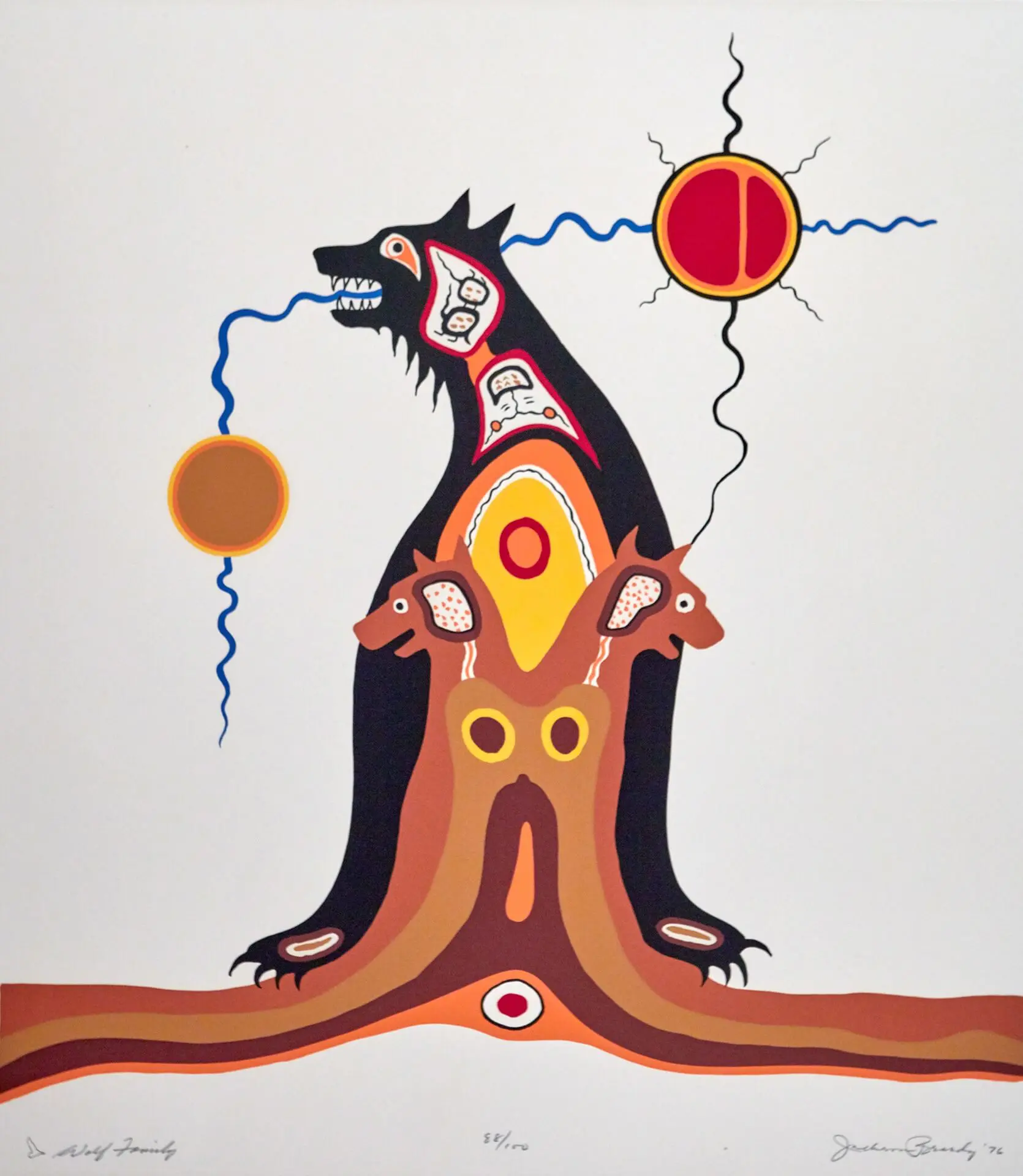
Wolf Family, 1976
Silkscreen
Gift of Dr. Ronald Olin
Understanding Jackson Beardy’s background is essential to looking deeper in the Wolf Family. What is being illustrated is not only a scene of nature, but an expression of Anisininew teachings of bonds between all living things.
Jackson Beardy (July 24, 1944 – December 7, 1984) was an Anisininew artist from Garden Hill First Nation in Manitoba, Canada. Beardy was the fifth of thirteen children and lived in a one roomed cabin in his early life. For the better part of his childhood he stayed with his maternal grandmother, who taught him oral traditions and history from their Anisininew culture.
At seven years old, Beardy and his sister were forced into a residential school at Portage la Prairie in Southern Manitoba. While it chipped away his culture, ironically, this is the place he found his love for art. At sixteen, the Canadian authorities allowed students to leave the school. The principal promised Beardy an art education if he finished his last two years of school so Beardy stayed. Beardy never received his promised art education because the principal went back on his word. Jackson would have to pursue an art education by himself.
In the last year of high school, Jackson struggled with alcoholism, and had to retake his failed classes. He attended Technical Vocational High School and School of Art at the University of Manitoba for commercial art. Jackson Beardy was a prominent member of Woodlands School of Indigenous Art and the Professional Native Indian Artist Inc. (or the Indian Group of Seven).
The central figures in the work are wolves. The largest wolf is rooted to the ground and coming between two suns, which are joined by one wavy blue line passing through the wolf’s mouth. Inside the wolf, there are two smaller conjoined symmetrical wolves coming up from the ground as well, seemingly safely nestled within the larger body. The top right sun is divided within itself and yet connected to the smaller wolf on the right by the same wavy line.
The entire composition resembles a “cell structure” or “X-ray” which is a notable feature of the Woodland art style. The perspective is frontal and flat, with the x-ray components giving the viewer a look into the physical and or spiritual anatomy of the figures. The dominant colors are deep reds, bright yellow and orange, and dark browns and black.
Interconnectedness and interdependence is a core subject in this artwork, as it is a common theme in most Anisininew oral traditions. Jackson Beardy drew his artistic inspiration from Anisininew oral tradition, which he relearned after being disconnected from them for so long. In Anisininew belief, humans and wolves (ma’iingan or mahihkan) have a strong kinship. In the early beginning of earth, human and wolf were brothers. The brothers were given the task by the creator to name all the living things on earth. When they finished, the creator told them to take their separate paths, and even though they won’t be brothers, their spirits will be permanently connected.
In Woodlands School art, heavy waving lines are derived from ancient Anishinaabe rock pictographs or Midewiwin birchbark to be a visual of life flowing between all things on earth. The lines themselves have the purpose of showing that nothing in the world isn’t connected to something. As for the divided circle, it reflects the dualism in life.
When I first saw this I interpreted it as rebirth. I related it strongly to vivipary, when the “baby” plant grows inside of the parent plant’s fruit or flower (ex. green sprouts inside a tomato). I saw that same process within the wolf. I thought that the largest wolf was a fierce protector only because of the opened mouth and teeth. What I see now is something very harmonious. Now the wolf looks like it is giving a message.
As a viewer, how did Wolf Family look at first to you? How different is your initial interpretation to your current one?